Sequential Neural Likelihood Estimation with C++
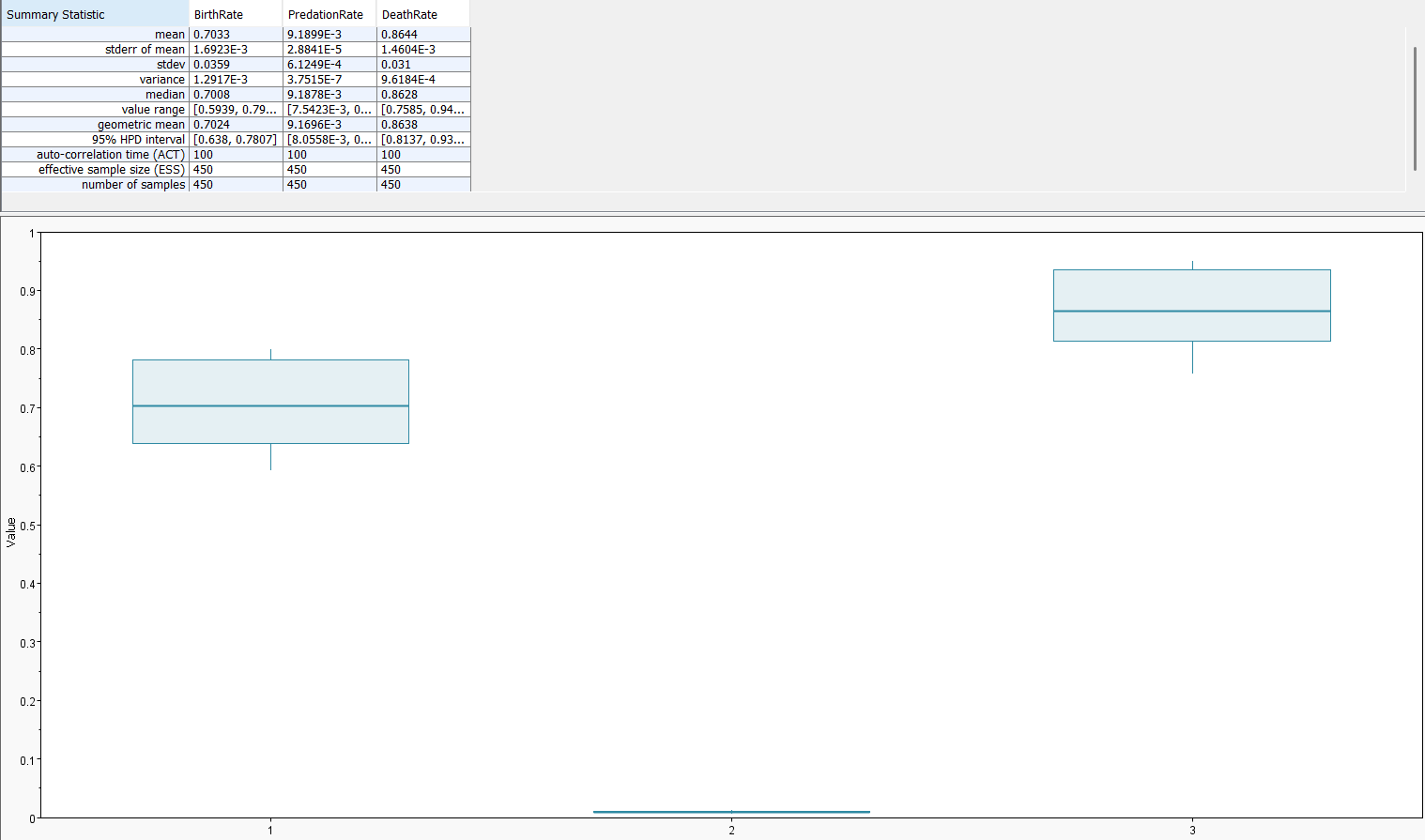
A recent pre-print by Blassel et al. (2025) renewed my interest in simulation-based inference. In this post, I revisit my sequential neural likelihood estimator for the partially observed stochastic Lotka–Volterra model, reimplemented in C++ using LibTorch and Boost. I assume familiarity with that earlier post and with SNLE in general, and concentrate here on providing C++ implementation. The model itself is nearly identical, with the exception that predator birth is now directly tied to predation in the Gillespie simulator. I also decided that this time I would run Markov chain Monte Carlo with my neural likelihood and determine how good my posterior distributions for the parameters \(\beta_{birth}\), \(\beta_{predation}\), \(\beta_{death}\). In this case, we had \((\beta_{birth},\beta_{predation}, \beta_{death}) = (0.75,0.01,0.9)\). The posterior mass concentrates around the true parameters, indicating that our neural likelihood captures the relevant structure of the simulator for these parameter choices.
CMakeLists.txt
cmake_minimum_required(VERSION 3.20)
project(SNLE-LV LANGUAGES CXX)

set(CMAKE_CXX_STANDARD 23)
set(CMAKE_CXX_STANDARD_REQUIRED ON)
set(CMAKE_CXX_EXTENSIONS OFF)

set(CMAKE_PREFIX_PATH "/libtorch/")
find_package(Torch REQUIRED)
find_package(Boost REQUIRED)
set(CMAKE_CXX_FLAGS "${CMAKE_CXX_FLAGS} ${TORCH_CXX_FLAGS}")

add_executable(snle_lv snle_lv.cpp)
target_link_libraries(snle_lv "${TORCH_LIBRARIES}")
target_link_libraries(snle_lv Boost::boost)
snle_lv.cpp
#include <iostream>
#include <fstream>
#include <torch/torch.h>
#include <boost/random/mersenne_twister.hpp>
#include <boost/random/exponential_distribution.hpp>
#include <boost/random/uniform_01.hpp>
#include <boost/random/exponential_distribution.hpp>

/**
 * @brief This is the conditional autoregressive normalizing flow we will use to estimate the
 * likelihood. The general layout here is that there are some embedding layer that takes in the conditionals
 * of the probability distribution
 */
struct ConditionalAutoregressiveFlow : torch::nn::Module {
    ConditionalAutoregressiveFlow(void) = delete;
    ConditionalAutoregressiveFlow(int nF = 3) : numFlows(nF),
                                                l1e(register_module("l1e", torch::nn::Linear(5, 16))) {

        register_module("flow1Lin", flow1Lin);
        register_module("flow2Lin", flow2Lin);
        register_module("flow1Param", flow1Param);
        register_module("flow2Param", flow2Param);

        for(int i = 0; i < numFlows; i++){
            flow1Lin->push_back(torch::nn::Linear(16, 16));
            flow2Lin->push_back(torch::nn::Linear(17, 16));
            flow1Param->push_back(torch::nn::Linear(16, 2));
            flow2Param->push_back(torch::nn::Linear(16, 2));
        }
    }

    /**
     * @brief Sends data in the normalizing direction and returns the NLL from the Base distribution
     */
    torch::Tensor forward(torch::Tensor augmentedData){
        auto e = torch::log(augmentedData.index({torch::indexing::Slice(), torch::indexing::Slice(0, 5)}).clone());
        auto data = torch::log(augmentedData.index({torch::indexing::Slice(), torch::indexing::Slice(5, 7)}).clone());
        int conditionalDim = 1;
        torch::Tensor jacobianSum = torch::sum(data, -1);

        e = torch::relu(l1e(e));

        for(int i = 0; i < numFlows; i++){
            // Handle Non-Conditional Affine
            auto localEmbed = torch::relu(flow1Lin[i]->as<torch::nn::Linear>()->forward(e));
            auto p1 = flow1Param[i]->as<torch::nn::Linear>()->forward(localEmbed);
            auto scale1 = torch::softplus(p1.index({torch::indexing::Slice(), 1}));
            auto shift1 = p1.index({torch::indexing::Slice(), 0});
            auto nonCondView = data.index({torch::indexing::Slice(), conditionalDim ^ 1});
            nonCondView.div_(scale1);
            nonCondView.sub_(shift1);
            jacobianSum -= torch::log(scale1);

            // Handle Conditional Affine
            localEmbed = torch::relu(
                flow2Lin[i]->as<torch::nn::Linear>()->forward(
                    torch::concat({e, nonCondView.unsqueeze(-1)}, -1)
                )
            );
            auto p2 = flow2Param[i]->as<torch::nn::Linear>()->forward(localEmbed);
            auto scale2 = torch::softplus(p2.index({torch::indexing::Slice(), 1}));
            auto shift2 = p2.index({torch::indexing::Slice(), 0});
            auto condView = data.index({torch::indexing::Slice(), conditionalDim});
            condView.div_(scale2);
            condView.sub_(shift2);
            jacobianSum -= torch::log(scale2);

            conditionalDim ^= 1; // Flip Conditionality
        }

        torch::apply([](auto& datum){ datum = -0.5 * (datum*datum); }, data);
        data = torch::sum(data, -1);
        if(torch::any(torch::isnan(data)).item<bool>()){
            std::cout << augmentedData.index({torch::nonzero(torch::isnan(data)).squeeze()}).slice(-1, -4) << std::endl;
            std::cout << "Detected NaNs! Dumping all values ^" << std::endl;
            std::exit(1);
        }
        return -1.0 * (data + jacobianSum); // Apply the Jacobian and return NLL
    }

    // @todo Add sampling function

    void train(int epochs, torch::Tensor data, double threshold = 1e-6){
        torch::optim::Adam optim(
            this->parameters(),
            torch::optim::AdamOptions(1e-3).betas(std::make_tuple(0.5, 0.5))
        );

        int patience = 0;
        double lastBestLoss = INFINITY;

        for(int epoch = 1; epoch <= epochs; epoch++){

            this->zero_grad();
            auto loss = this->forward(data).mean(); // Mean NLL Loss
            double lossScalar = loss.item<double>();
            loss.backward();
            torch::nn::utils::clip_grad_norm_(this->parameters(), 1.0); // Clip Gradients For Stability
            optim.step();

            if(lossScalar + threshold < lastBestLoss){
                patience = 0;
                lastBestLoss = lossScalar;
            }
            else{
                patience++;
            }

            if(patience > 50){
                std::cout << "Early Stopping at " << epoch << std::endl;
                break;
            }

            if(epoch % 10 == 0)
                std::cout << "Average Loss of {" << lossScalar << "} at Epoch " << epoch << std::endl;
        }
    }

    private:
        int numFlows;

        // Embedding Block (Generate an internal representation from the context)
        torch::nn::Linear l1e;
        // Flow Blocks
        torch::nn::ModuleList flow1Lin;
        torch::nn::ModuleList flow2Lin;
        torch::nn::ModuleList flow1Param;
        torch::nn::ModuleList flow2Param;
};

/**
 * @brief Generate data under the stochastic Lotka-Voltera model.
 */
torch::Tensor generativeModel(boost::random::mt19937& rng, double time, int numSamples, torch::Tensor initState, double birthRate, double predationRate, double deathRate){
    // Put a floor on these values
    birthRate += 1e-2;
    predationRate += 1e-2;
    deathRate += 1e-2;

    torch::Tensor currentState = initState;
    double currentTime = 0.0;
    double sampleFrequency = time / (double)(numSamples);
    int currentSample = 1;
    torch::Tensor samples = torch::zeros({numSamples, 2});
    samples.index_put_({0}, initState);

    // Simulate with the Gillespie algorithm
    while(currentSample < numSamples){

        double currentPrey = currentState[0].item<double>();
        double currentPredators = currentState[1].item<double>();
        if(currentPrey == 0.0 && currentPredators == 0.0){ // Quit upon total extinction
            break;
        }

        double birthPoisson = birthRate * currentPrey;
        double predationPoisson = predationRate * currentPredators * currentPrey;
        double deathPoisson = deathRate * currentPredators;

        double exponentialRaceRate = birthPoisson + predationPoisson + deathPoisson;
        double waitingTime = boost::random::exponential_distribution<double>{exponentialRaceRate}(rng);

        currentTime += waitingTime;

        double randomUpdate = boost::random::uniform_01<double>{}(rng);
        if(randomUpdate < birthPoisson / exponentialRaceRate){
            currentPrey++;
        }
        else if(randomUpdate < (birthPoisson + predationPoisson) / exponentialRaceRate){
            currentPrey--;
            currentPredators++;
        }
        else{
            currentPredators--;
        }

        currentState.index_put_({0}, currentPrey);
        currentState.index_put_({1}, currentPredators);

        // Catch up on (potentiall multiple) sampling events
        for(; currentTime >= sampleFrequency * (double)currentSample && currentSample < numSamples; currentSample++){
            samples.index_put_({currentSample}, currentState);
        }

    }

    auto shiftedSamples = torch::roll(samples, 1, 0);
    auto multiplicativeIncrease = torch::divide(samples, shiftedSamples);
    multiplicativeIncrease = torch::where(torch::isnan(multiplicativeIncrease), 1e-6, multiplicativeIncrease);
    multiplicativeIncrease = torch::where(multiplicativeIncrease == 0.0, 1e-6, multiplicativeIncrease);
    shiftedSamples = torch::where(shiftedSamples == 0.0, 1e-6, shiftedSamples);

    auto augmentedData = torch::concat({shiftedSamples, multiplicativeIncrease}, -1);
    augmentedData = augmentedData.slice(0, 1, augmentedData.size(0));

    return augmentedData;
}

int main(int argc, char** argv){
    auto rng = boost::random::mt19937{1124};

    double initPrey = 60.0;
    double initPredator = 10.0;
    double truePreyBirth = 0.75;
    double truePredation = 0.01;
    double truePredatorDeath = 0.9;
    double simulationTime = 40;
    int numSamples = 200;
    auto initState = torch::tensor({60.0, 10.0});

    std::cout << "Simulating Data..." << std::endl;
    auto simulatedData = generativeModel(rng, simulationTime, numSamples, initState.clone(), truePreyBirth, truePredation, truePredatorDeath);
    std::cout << simulatedData << std::endl;

    auto trainingData = torch::empty({0, 7});;

    int numSNLEIterations = 4;
    int mcmcIterations = 20000;
    int samplingFrequency = 1000;
    int priorSamples = 100;
    int samplingIterations = 10;
    std::array<double, 3> lambdas = {3.0, 20.0, 3.0};
    auto unif = boost::random::uniform_01();

    for(int i = 1; i <= numSNLEIterations; i++){
        std::cout << "Starting SNLE Iteration " << i << std::endl;

        if(i > 1){
            ConditionalAutoregressiveFlow neuralLikelihood(4);
            neuralLikelihood.train(5000, trainingData);

            std::array<double, 3> currentParams = {
                boost::random::exponential_distribution{lambdas[0]}(rng),
                boost::random::exponential_distribution{lambdas[1]}(rng),
                boost::random::exponential_distribution{lambdas[2]}(rng)
            };
            double currentPrior = 0.0;
            for(int i = 0; i < 3; i++){
                currentPrior += std::log(lambdas[i]) - lambdas[i] * currentParams[i];
            }

            auto simDim = simulatedData.size(0);
            double currentLL = -1.0 * neuralLikelihood.forward(
                torch::concat({
                    torch::full({simDim, 1}, currentParams[0]),
                    torch::full({simDim, 1}, currentParams[1]),
                    torch::full({simDim, 1}, currentParams[2]),
                    simulatedData
                }, 1)
            ).sum().item<double>();

            for(int j = 1; j <= mcmcIterations; j++){

                for(int gibbsIter = 0; gibbsIter < 3; gibbsIter++){
                    double scalingFactor = std::exp(1.5 * (unif(rng) - 0.5));
                    std::array<double, 3> newParams = currentParams;
                    newParams[gibbsIter] = currentParams[gibbsIter] * scalingFactor;
                    double newPrior = 0.0;
                    for(int i = 0; i < 3; i++){
                        newPrior += std::log(lambdas[i]) - lambdas[i] * newParams[i];
                    }

                    double newLL = -1.0 * neuralLikelihood.forward(
                        torch::concat({
                            torch::full({simDim, 1}, newParams[0]),
                            torch::full({simDim, 1}, newParams[1]),
                            torch::full({simDim, 1}, newParams[2]),
                            simulatedData
                        }, 1)
                    ).sum().item<double>();

                    double logRatio = std::log(scalingFactor) + newLL - currentLL + newPrior - currentPrior;
                    if(std::log(unif(rng)) <= logRatio){
                        currentPrior = newPrior;
                        currentLL = newLL;
                        currentParams = newParams;
                    }
                }

                if(j % samplingFrequency == 0){
                    for(int simIter = 0; simIter < samplingIterations; simIter++){
                        auto newData = generativeModel(rng, simulationTime/4.0, numSamples/4, initState.clone(), currentParams[0], currentParams[1], currentParams[2]);
                        auto newDataDim = newData.size(0);
                        newData = torch::concat({
                            torch::full({newDataDim, 1}, currentParams[0]),
                            torch::full({newDataDim, 1}, currentParams[1]),
                            torch::full({newDataDim, 1}, currentParams[2]),
                            newData
                        }, 1);

                        trainingData = torch::concat({trainingData, newData}, 0);
                    }

                    std::cout << j << " ( " << currentLL << " ):\tBirth: " << currentParams[0] << "\t Predation: " << currentParams[1] << "\tDeath: " << currentParams[2] << std::endl;
                }
            }
        }
        else {
            for(int j = 1; j <= priorSamples; j++){
                std::array<double, 3> currentParams = {
                    boost::random::exponential_distribution{lambdas[0]}(rng),
                    boost::random::exponential_distribution{lambdas[1]}(rng),
                    boost::random::exponential_distribution{lambdas[2]}(rng)
                };

                for(int simIter = 0; simIter < samplingIterations; simIter++){
                    auto newData = generativeModel(rng, simulationTime/4.0, numSamples/4, initState.clone(), currentParams[0], currentParams[1], currentParams[2]);
                    auto newDataDim = newData.size(0);
                    newData = torch::concat({
                        torch::full({newDataDim, 1}, currentParams[0]),
                        torch::full({newDataDim, 1}, currentParams[1]),
                        torch::full({newDataDim, 1}, currentParams[2]),
                        newData
                    }, 1);

                    trainingData = torch::concat({trainingData, newData}, 0);
                }

                std::cout << j << "\tBirth: " << currentParams[0] << "\t Predation: " << currentParams[1] << "\tDeath: " << currentParams[2] << std::endl;
            }
        }
    }

    // Run MCMC one final time to get a trace file
    ConditionalAutoregressiveFlow neuralLikelihood(4);
    neuralLikelihood.train(5000, trainingData);

    int mcmcSamplingFreq = 100;
    int finalMcmcIter = 50000;
    std::ofstream outputFile("./output.trace");
    outputFile << "Iteration\tPosterior\tBirthRate\tPredationRate\tDeathRate" << std::endl;

    std::array<double, 3> currentParams = {
        boost::random::exponential_distribution{lambdas[0]}(rng),
        boost::random::exponential_distribution{lambdas[1]}(rng),
        boost::random::exponential_distribution{lambdas[2]}(rng)
    };
    double currentPrior = 0.0;
    for(int i = 0; i < 3; i++){
        currentPrior += std::log(lambdas[i]) - lambdas[i] * currentParams[i];
    }

    auto simDim = simulatedData.size(0);
    double currentLL = -1.0 * neuralLikelihood.forward(
        torch::concat({
            torch::full({simDim, 1}, currentParams[0]),
            torch::full({simDim, 1}, currentParams[1]),
            torch::full({simDim, 1}, currentParams[2]),
            simulatedData
        }, 1)
    ).sum().item<double>();

    for(int j = 1; j <= finalMcmcIter; j++){

        for(int gibbsIter = 0; gibbsIter < 3; gibbsIter++){
            double scalingFactor = std::exp(1.5 * (unif(rng) - 0.5));
            std::array<double, 3> newParams = currentParams;
            newParams[gibbsIter] = currentParams[gibbsIter] * scalingFactor;
            double newPrior = 0.0;
            for(int i = 0; i < 3; i++){
                newPrior += std::log(lambdas[i]) - lambdas[i] * newParams[i];
            }

            double newLL = -1.0 * neuralLikelihood.forward(
                torch::concat({
                    torch::full({simDim, 1}, newParams[0]),
                    torch::full({simDim, 1}, newParams[1]),
                    torch::full({simDim, 1}, newParams[2]),
                    simulatedData
                }, 1)
            ).sum().item<double>();

            double logRatio = std::log(scalingFactor) + newLL - currentLL + newPrior - currentPrior;
            if(std::log(unif(rng)) <= logRatio){
                currentPrior = newPrior;
                currentLL = newLL;
                currentParams = newParams;
            }
        }

        if(j % mcmcSamplingFreq == 0){
            outputFile << j << "\t" << currentLL + currentPrior << "\t" << currentParams[0] << "\t" << currentParams[1] << "\t" << currentParams[2] << std::endl;
            std::cout << j << " ( " << currentLL << " ):\tBirth: " << currentParams[0] << "\t Predation: " << currentParams[1] << "\tDeath: " << currentParams[2] << std::endl;
        }
    }


    return 0;

}